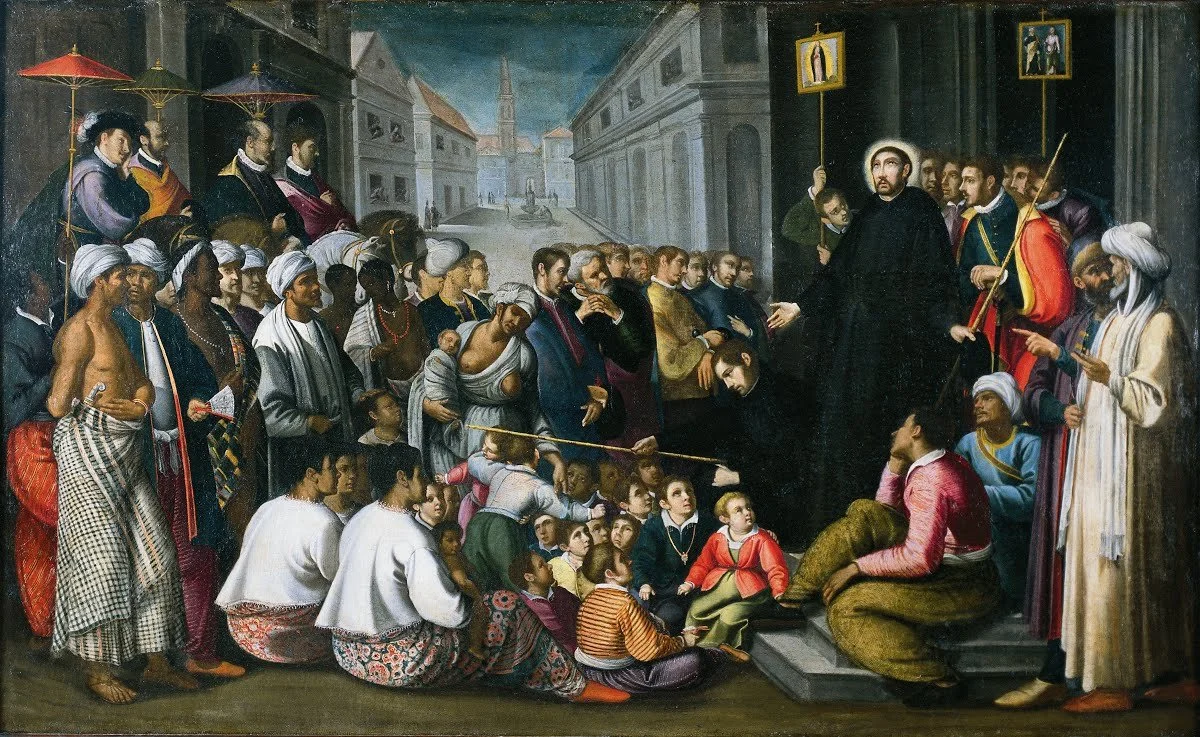
There is something uneasy about writing this, and I want to say why before I say anything else.
I am an art historian of South Asia. The objects I spend my professional life studying—ivory and wood objects, kalamkari, and checked cottons—were produced by artisan communities whose working conditions in their own time were shaped by tributary labor, caste hierarchy, and colonial extraction, and whose contemporary descendants work in industries where those structures have not so much dissolved as reorganized. When I write about artisan visibility at a fashion gala underwritten in part by Jeff Bezos, against a backdrop of widening inequality that is impossible to separate from the global fashion industry itself, I am not standing outside the spectacle offering critique; I am inside it, doing a version of the aestheticizing work the event requires.
That does not mean the observations below are worthless. But it means they should be held at arm's length, including by me.
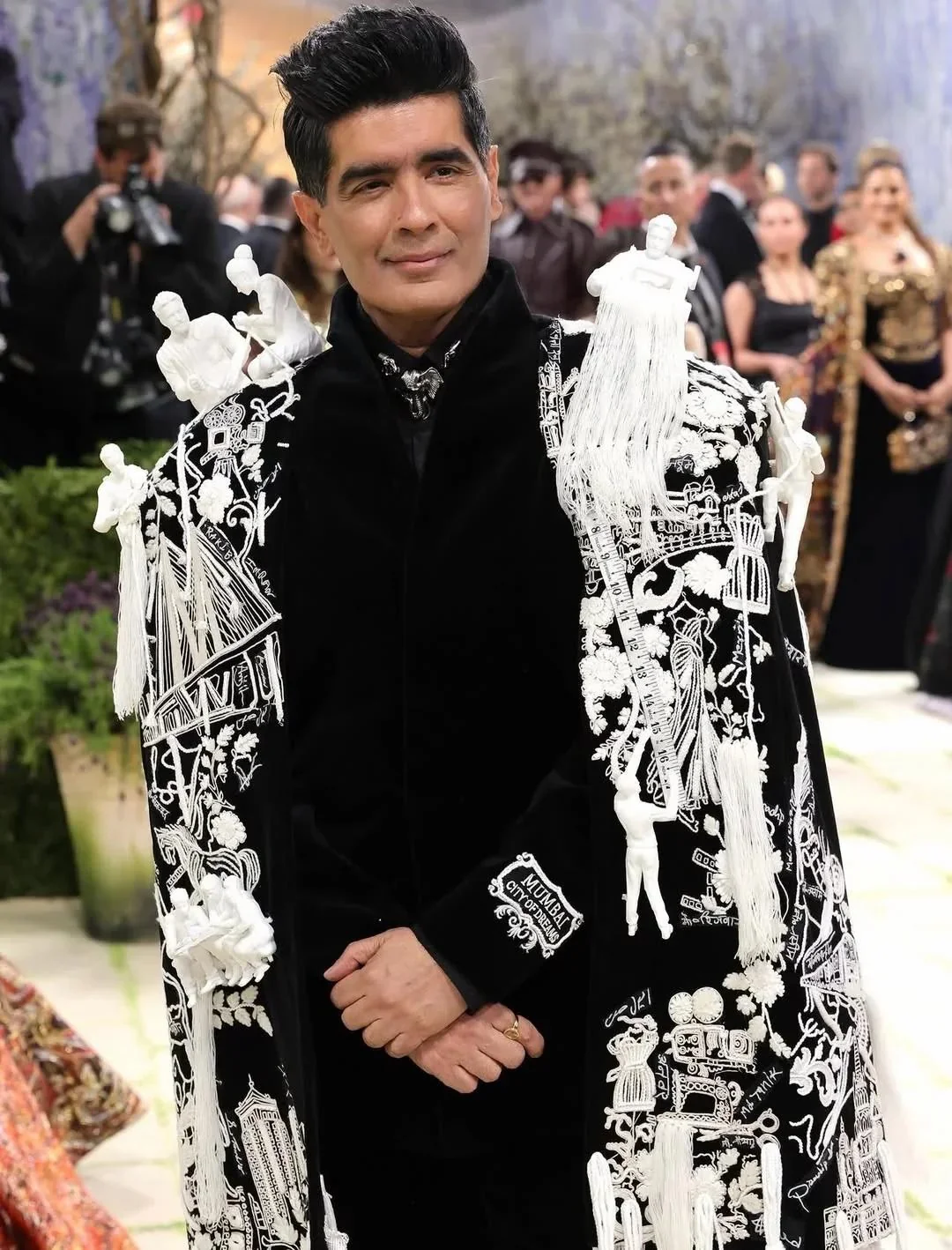
With that said: within a spectacle that mostly confirmed the logic of global luxury fashion, there were two ensembles that I find worth thinking about carefully, both designed by one of India’s most popular fashion designers, Manish Malhotra. The two costumes that caught my attention this year instantly was Karan Johar’s Raja Ravi Varma inspired cape and, even more stunning, Manish Malhotra’s cape “tribute” to the city of Mumbai and his atelier.
The Met Gala began in 1948 as a fundraiser for the Metropolitan Museum's Costume Institute, conceived by publicist Eleanor Lambert as a midnight supper for New York society and the garment trade. It was Diana Vreeland, joining as a consultant in 1972, who introduced the exhibition-led theme structure and relocated the event to the museum itself, transforming it from an industry dinner into a cultural occasion. Anna Wintour's assumption of leadership in 1995 completed the metamorphosis: the Gala became a tightly managed spectacle of curated celebrity, global media reach, and increasingly stratospheric ticket prices—rumored this year at up to $100,000 a seat—that has made it, in its own self-description, the Oscars of the East Coast.
The event is structured around the Costume Institute's annual spring exhibition, and guests are expected to interpret the exhibition's theme in their dress. This year's theme for the gala is “Fashion is Art”. The featured exhibition is the first to open in the new Condé M. Nast Galleries, and examines the dressed body across the museum's collections, juxtaposing garments and works of art to illuminate new connections, with nearly 400 objects contributing to the museum's initiative of displaying and appreciating fashion as an art form. Curator-in-Charge Andrew Bolton framed it as acknowledging fashion’s critical role not only within contemporary culture but within art history itself.
The premise, of “fashion as art,” while not wrong is also a specific ideological move: it elevates the designer as author, positions the garment as singular aesthetic object, and—crucially—in my opinion, tends to render invisible contemporary labor structures through which that object came into being. Art historical discourse has long struggled with this problem around objects of craft and applied art; the Costume Institute, in naming its new exhibition “Costume Art,” is leaning into a tradition that has often resolved the tension between making and meaning by aestheticizing the former into irrelevance. That context matters for what Manish Malhotra and Karan Johar brought to the Met steps, because both ensembles engage the theme’s complicated premise.
Malhotra’s own ensemble has been widely discussed already, and rightly so. The black bandhgala and embroidered cape reportedly required over 960 hours of labor by more than 50 artisans across Mumbai and Delhi. They are structured as dense surfaces of accumulated craft: zardozi, chikankari, dori work, kasab embroidery worked in white against black, a palette that functions less like a design choice than like a city seen at night. The imagery on the cape is unmistakably Mumbai—the Gateway of India, Chhatrapati Shivaji Terminus (formerly Queen Victoria Terminus), the Taj Mahal Palace Hotel, trains, taxis—but the cape is not a postcard. What the dense white-on-black embroidery captures is something closer to the city’s texture: aspiration and grittiness held in the same frame, pressing against each other. Among the architectural landmarks, the artisans themselves appear as sculpted figures, worked into the design, visible in the act of making.
For me, the most conceptually charged feature is the naming. The artisans are not credited in a caption or a press release; their names—Vipin, Karim, Abdul, Das—are inscribed on the garment itself, rendered in Hindi, Urdu, and English in what appears to be their handwriting. The multiplicity of languages in use is meaningful: these are not a generic “team” but specific individuals whose linguistic and cultural identities are as present as their labor. The names themselves signal something about the community composition of the workshops—Muslim artisans predominate in zardozi and chikankari production, particularly in the Lucknow belt and the Mumbai ateliers that draw on those traditions, communities whose skilled labor has been systematically undervalued and whose cultural identification with the craft rarely survives the translation into luxury branding. In an industry where the work of karigars is structurally absorbed into the singular authorship of the designer, dissolved into the abstraction of “the atelier,” inscribing those names in their own scripts is a genuine interruption—and a pointed one within an event whose theme is premised on the designer as artist. (But criticism follows, wait for it.)
This visibility matters especially because we are watching the opposite tendency play out in real time. When Prada marketed footwear closely resembling Kolhapuri chappals without attribution, or when a chunri circulates on social media rebranded as a "Scandinavian scarf," what is being erased is not simply geographic origin and cultures of making that are centuries old but also the labor; skilled, community-based, historically embedded labor that does not register within Western fashion's vocabulary for craft.
Producer-Director celebrity extraordinaire of Bollywood, Karan Johar’s look works differently, and the dimension of it that interests me most has gone almost entirely unnoticed.
The nearly six-foot hand-painted cape draws on Raja Ravi Varma—specifically Hamsa Damayanti, Kadambari, and Arjuna and Subhadra—and the choice of Ravi Varma is not incidental. Ravi Varma was among the first Indian artists to bridge European academic painting with Hindu mythological subject matter, bringing Hindu narrative imagery into modernity through print and mass reproduction in ways that permanently shaped how those stories were visualized across the subcontinent and diaspora. To invoke him at the Met Gala is to invoke that history of mediation itself: the work of making Indian mythological imagery legible across cultural and technological registers. It is particularly interesting to note that when Ravi Varma’s own work was first exhibited in the US, they were exhibited at The World’s Columbian Exposition in Chicago in 1893 where the artists’ work was deemed as “ethonographic paintings” and not as “art work" because it was considered Indian, derivative, and so on. And here, 130 odd years later, a cape that imitates and presents the work of Ravi Varma is presented at one of the world’s largest art stage as a mark of Indian couture and artistic ingenuity.
How did Malhotra and Johar and their team choose the paintings I wonder? Hamsa Damayanti—Damayanti recognizing Nala among the gods who have taken his form—is a scene about desire and discernment across the divine-human threshold. Arjuna and Subhadra stages the elopement facilitated by Krishna’s mediation, a crossing of social and cosmic boundaries. Kadambari, from Banabhatta's Sanskrit novel, evokes the court lady as figure of refined aesthetic sensibility, of pleasure and loss. Feminine beauty and idealized femininity and familiality is the theme of There Comes Papa. These are not interchangeable Ravi Varma subjects. Where these intentionally chosen because they are Varma’s best known works or is there a symbolic register at work here? Either way, I would say that Johar’s cape is performing at the Met Gala in New York in ways that Ravi Varma’s own works never did at the 1893 World’s Exposition in Chicago.
Then there is the technique. Painting directly onto cloth situates Johar’s cape within a much longer history of painted and printed textiles in India, most significantly kalamkari—the hand-painted and resist-printed cotton produced along India’s Coromandel Coast, among the most significant Indian export commodities of the early modern period, circulating through Indian Ocean trade networks to Europe in enormous quantities from the seventeenth century onward. The Met holds a substantial collection of kalamkari textiles among its South Asian holdings. This year’s “Costume Art” exhibition positions itself as exploring the dressed body across the museum's own collections—and yet Johar’s hand-painted cape was carried up the steps of an institution housing some of the finest surviving examples of precisely that tradition, and as far as I can tell, that connection went entirely unremarked by anyone covering the event. The Met’s own holdings were not part of the conversation about a hand-painted textile made by Indian artisans, displayed at the Met, in a year when the exhibition theme explicitly claims to be drawing connections between fashion and the museum’s art historical collections.
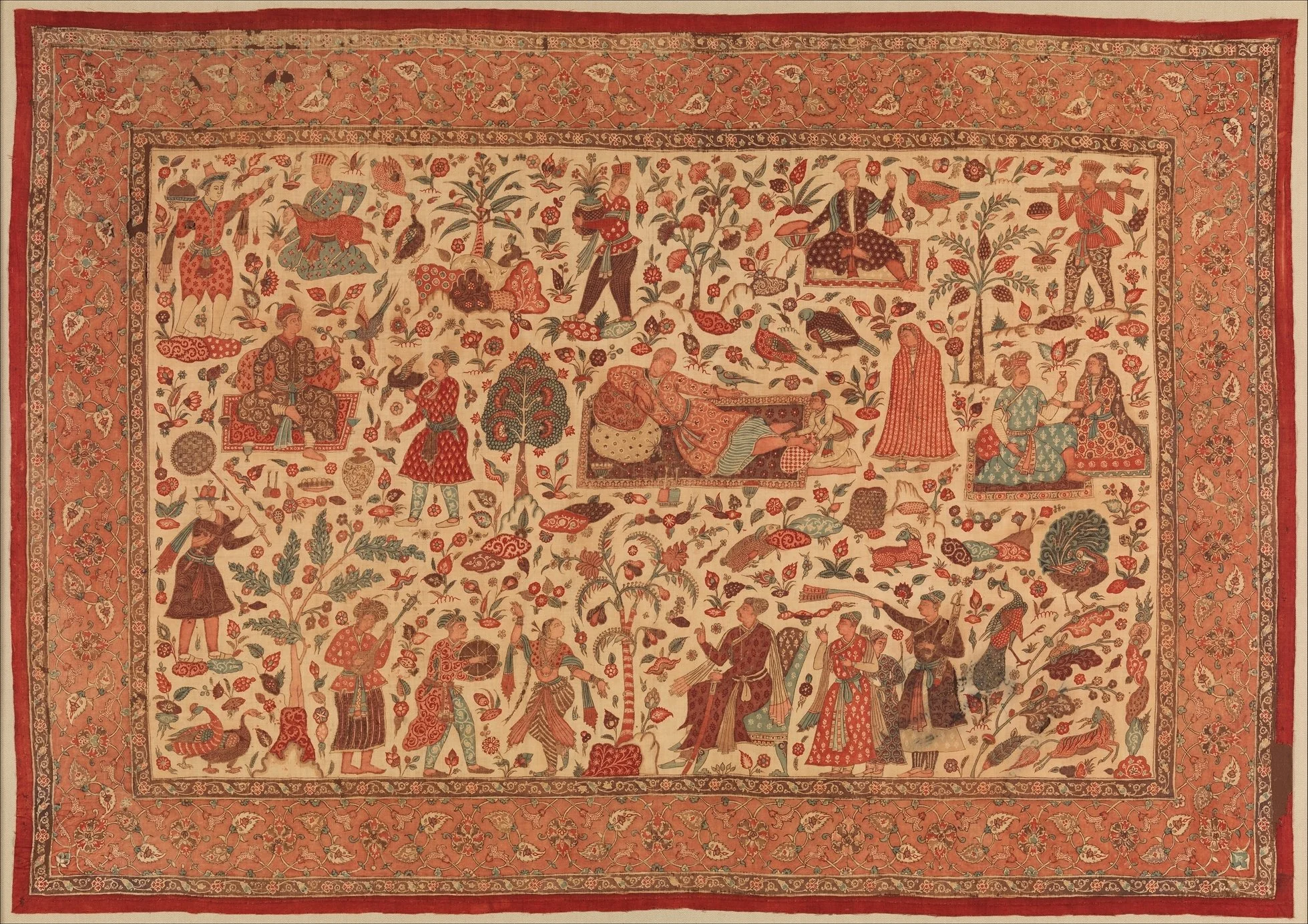
Kalamkari Rumal, c.1640-50, at The Met
I want to sit with that for a moment, because it is not simply an oversight. It reflects something about how the Gala and the museum operate as adjacent but non-communicating systems, and about whose art histories the “Costume Art” frame actually encompasses. The spectacle of contemporary fashion and the archive of historical craft do not speak to each other, even when they are literally in the same building. The institutional knowledge that might have made that connection visible, that might have asked what it means for painted cloth to return to an institution that holds its predecessors, was not part of the event’s frame. For an exhibition explicitly premised on illuminating connections between garments and the museum’s collections, that silence is telling.
This is where I want to think carefully rather than simply celebrate, and where I find myself in the most difficulty.
The visibility these ensembles create is real. But visibility and legibility are not the same thing as redistribution, and there is a version of this—one I am not sure we are not already watching—where “artisan visibility” becomes luxury narrative, where naming workers is part of the value proposition of couture rather than a challenge to its structure. The named artisans appear within Malhotra’s authorship, within the branding apparatus of couture, within a global event whose gatekeeping mechanisms are themselves a form of capital. “Fashion is Art” is, among other things, a frame that increases the cultural and therefore economic value of the objects it certifies. Naming artisans within that frame does not necessarily interrupt it; it may simply make the luxury object more legible, more storied, more valuable.
The deeper structures remain not merely unaddressed but largely unaskable within the celebratory frame. Naming artisans does not tell us about the artist composition in embroidery workshops. For instance, caste/religion is not incidental here when thinking about artist since the organization of skilled craft labor in India has been and remains structured by it. Naming artisans does not tell us about wage hierarchies within subcontracting chains, or about the gap between the labor hours cited in press releases and what artisans are actually paid for them. It does not tell us how value flows across the production process, or whether visibility at the Met Gala translates into anything material for Vipin, Karim, Abdul, and Das. These questions are not answerable from the red carpet. But the work of asking them—pursued by journalists and researchers who cover artisan economies, by labor organizers in the garment sector, by craft historians—exists, and the Gala’s frame does not acknowledge it. The ensembles open a door that the event structure immediately closes.
I am also aware that writing this analysis performs its own kind of value extraction: I am using these garments, and by extension these artisans and their labor, to demonstrate a set of art-historical competencies. The kalamkari observation is genuinely mine, but it is also convenient for me in ways I should not pretend are neutral.
None of this is reason to look away—from the garments, or from the difficulty.
What stays with me about both ensembles is that they refuse a certain simplification. They are not garments that flatten themselves for global readability. Instead, they insist on something the framing of “Fashion is Art” tends to suppress: that these objects were made, by specific people, drawing on specific traditions with specific histories, and that the making is not background but argument. The embroidery is not decorative accent; it is the argument. The Ravi Varma paintings are not backdrop; they are the subject-matter. Joharn and Malhotra did not wear abstracted “Indian” aesthetic to the Met steps; they showcased specific iconographic traditions, specific content and techniques with a specific history chosen with enough care to repay close reading. Malhotra did not gesture at artisan labor; he made it structurally present within the garment’s visual logic.
Now this is not structural change. It does not reach the caste hierarchies or the wage structures or the subcontracting chains. It does not resolve the irony of gesturing toward artisan communities within an event that now charges $100,000 a seat and counts tech billionaires among its underwriters. But within a context designed to transform everything into surface—including the “Fashion is Art” frame, which is also a way of aestheticizing things into palatability—these ensembles insisted on depth: on histories of making and meaning that do not resolve completely into spectacle without remainder.
Whether those openings get used is a different question, and a harder one. I am not sure this essay answers it.