Wearing India Loudly: Karan Johar and Manish Malhotra at the Met Gala 2026

There is something uneasy about writing this, and I want to say why before I say anything else.

I am an art historian of South Asia. The objects I spend my professional life studying—ivory and wood objects, kalamkari, and checked cottons—were produced by artisan communities whose working conditions in their own time were shaped by tributary labor, caste hierarchy, and colonial extraction, and whose contemporary descendants work in industries where those structures have not so much dissolved as reorganized. When I write about artisan visibility at a fashion gala underwritten in part by Jeff Bezos, against a backdrop of widening inequality that is impossible to separate from the global fashion industry itself, I am not standing outside the spectacle offering critique; I am inside it, doing a version of the aestheticizing work the event requires.

That does not mean the observations below are worthless. But it means they should be held at arm's length, including by me.

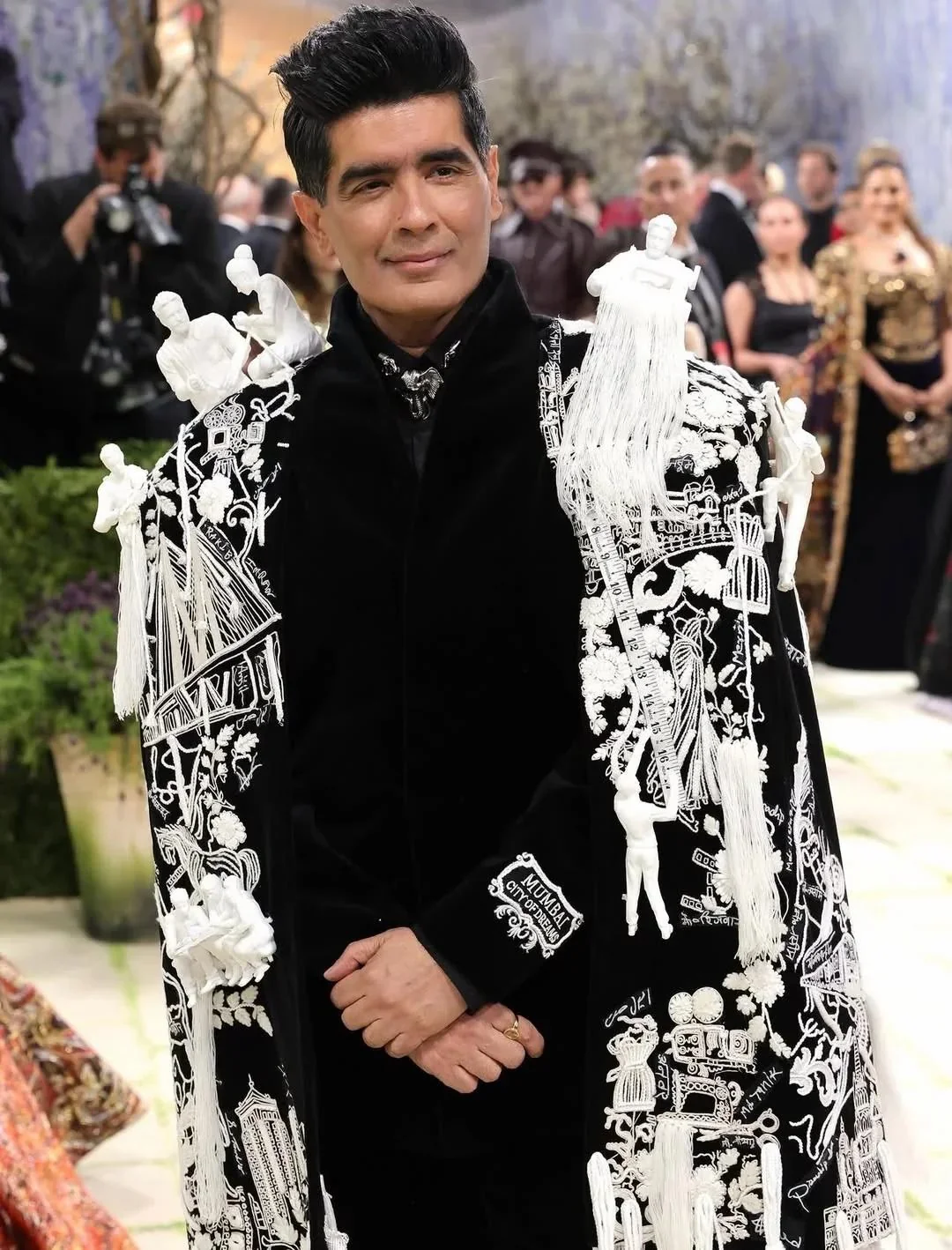
With that said: within a spectacle that mostly confirmed the logic of global luxury fashion, there were two ensembles that I find worth thinking about carefully, both designed by one of India’s most popular fashion designers, Manish Malhotra. The two costumes that caught my attention this year instantly was Karan Johar’s Raja Ravi Varma inspired cape and, even more stunning, Manish Malhotra’s cape “tribute” to the city of Mumbai and his atelier.
The Met Gala began in 1948 as a fundraiser for the Metropolitan Museum's Costume Institute, conceived by publicist Eleanor Lambert as a midnight supper for New York society and the garment trade. It was Diana Vreeland, joining as a consultant in 1972, who introduced the exhibition-led theme structure and relocated the event to the museum itself, transforming it from an industry dinner into a cultural occasion. Anna Wintour's assumption of leadership in 1995 completed the metamorphosis: the Gala became a tightly managed spectacle of curated celebrity, global media reach, and increasingly stratospheric ticket prices—rumored this year at up to $100,000 a seat—that has made it, in its own self-description, the Oscars of the East Coast.

The event is structured around the Costume Institute's annual spring exhibition, and guests are expected to interpret the exhibition's theme in their dress. This year's theme for the gala is “Fashion is Art”. The featured exhibition is the first to open in the new Condé M. Nast Galleries, and examines the dressed body across the museum's collections, juxtaposing garments and works of art to illuminate new connections, with nearly 400 objects contributing to the museum's initiative of displaying and appreciating fashion as an art form. Curator-in-Charge Andrew Bolton framed it as acknowledging fashion’s critical role not only within contemporary culture but within art history itself.

The premise, of “fashion as art,” while not wrong is also a specific ideological move: it elevates the designer as author, positions the garment as singular aesthetic object, and—crucially—in my opinion, tends to render invisible contemporary labor structures through which that object came into being. Art historical discourse has long struggled with this problem around objects of craft and applied art; the Costume Institute, in naming its new exhibition “Costume Art,” is leaning into a tradition that has often resolved the tension between making and meaning by aestheticizing the former into irrelevance. That context matters for what Manish Malhotra and Karan Johar brought to the Met steps, because both ensembles engage the theme’s complicated premise.

Malhotra’s own ensemble has been widely discussed already, and rightly so. The black bandhgala and embroidered cape reportedly required over 960 hours of labor by more than 50 artisans across Mumbai and Delhi. They are structured as dense surfaces of accumulated craft: zardozi, chikankari, dori work, kasab embroidery worked in white against black, a palette that functions less like a design choice than like a city seen at night. The imagery on the cape is unmistakably Mumbai—the Gateway of India, Chhatrapati Shivaji Terminus (formerly Queen Victoria Terminus), the Taj Mahal Palace Hotel, trains, taxis—but the cape is not a postcard. What the dense white-on-black embroidery captures is something closer to the city’s texture: aspiration and grittiness held in the same frame, pressing against each other. Among the architectural landmarks, the artisans themselves appear as sculpted figures, worked into the design, visible in the act of making.

For me, the most conceptually charged feature is the naming. The artisans are not credited in a caption or a press release; their names—Vipin, Karim, Abdul, Das—are inscribed on the garment itself, rendered in Hindi, Urdu, and English in what appears to be their handwriting. The multiplicity of languages in use is meaningful: these are not a generic “team” but specific individuals whose linguistic and cultural identities are as present as their labor. The names themselves signal something about the community composition of the workshops—Muslim artisans predominate in zardozi and chikankari production, particularly in the Lucknow belt and the Mumbai ateliers that draw on those traditions, communities whose skilled labor has been systematically undervalued and whose cultural identification with the craft rarely survives the translation into luxury branding. In an industry where the work of karigars is structurally absorbed into the singular authorship of the designer, dissolved into the abstraction of “the atelier,” inscribing those names in their own scripts is a genuine interruption—and a pointed one within an event whose theme is premised on the designer as artist. (But criticism follows, wait for it.)

This visibility matters especially because we are watching the opposite tendency play out in real time. When Prada marketed footwear closely resembling Kolhapuri chappals without attribution, or when a chunri circulates on social media rebranded as a "Scandinavian scarf," what is being erased is not simply geographic origin and cultures of making that are centuries old but also the labor; skilled, community-based, historically embedded labor that does not register within Western fashion's vocabulary for craft.

Producer-Director celebrity extraordinaire of Bollywood, Karan Johar’s look works differently, and the dimension of it that interests me most has gone almost entirely unnoticed.

The nearly six-foot hand-painted cape draws on Raja Ravi Varma—specifically Hamsa Damayanti, Kadambari, and Arjuna and Subhadra—and the choice of Ravi Varma is not incidental. Ravi Varma was among the first Indian artists to bridge European academic painting with Hindu mythological subject matter, bringing Hindu narrative imagery into modernity through print and mass reproduction in ways that permanently shaped how those stories were visualized across the subcontinent and diaspora. To invoke him at the Met Gala is to invoke that history of mediation itself: the work of making Indian mythological imagery legible across cultural and technological registers. It is particularly interesting to note that when Ravi Varma’s own work was first exhibited in the US, they were exhibited at The World’s Columbian Exposition in Chicago in 1893 where the artists’ work was deemed as “ethonographic paintings” and not as “art work" because it was considered Indian, derivative, and so on. And here, 130 odd years later, a cape that imitates and presents the work of Ravi Varma is presented at one of the world’s largest art stage as a mark of Indian couture and artistic ingenuity.

How did Malhotra and Johar and their team choose the paintings I wonder? Hamsa Damayanti—Damayanti recognizing Nala among the gods who have taken his form—is a scene about desire and discernment across the divine-human threshold. Arjuna and Subhadra stages the elopement facilitated by Krishna’s mediation, a crossing of social and cosmic boundaries. Kadambari, from Banabhatta's Sanskrit novel, evokes the court lady as figure of refined aesthetic sensibility, of pleasure and loss. Feminine beauty and idealized femininity and familiality is the theme of There Comes Papa. These are not interchangeable Ravi Varma subjects. Where these intentionally chosen because they are Varma’s best known works or is there a symbolic register at work here? Either way, I would say that Johar’s cape is performing at the Met Gala in New York in ways that Ravi Varma’s own works never did at the 1893 World’s Exposition in Chicago.

Then there is the technique. Painting directly onto cloth situates Johar’s cape within a much longer history of painted and printed textiles in India, most significantly kalamkari—the hand-painted and resist-printed cotton produced along India’s Coromandel Coast, among the most significant Indian export commodities of the early modern period, circulating through Indian Ocean trade networks to Europe in enormous quantities from the seventeenth century onward. The Met holds a substantial collection of kalamkari textiles among its South Asian holdings. This year’s “Costume Art” exhibition positions itself as exploring the dressed body across the museum's own collections—and yet Johar’s hand-painted cape was carried up the steps of an institution housing some of the finest surviving examples of precisely that tradition, and as far as I can tell, that connection went entirely unremarked by anyone covering the event. The Met’s own holdings were not part of the conversation about a hand-painted textile made by Indian artisans, displayed at the Met, in a year when the exhibition theme explicitly claims to be drawing connections between fashion and the museum’s art historical collections.
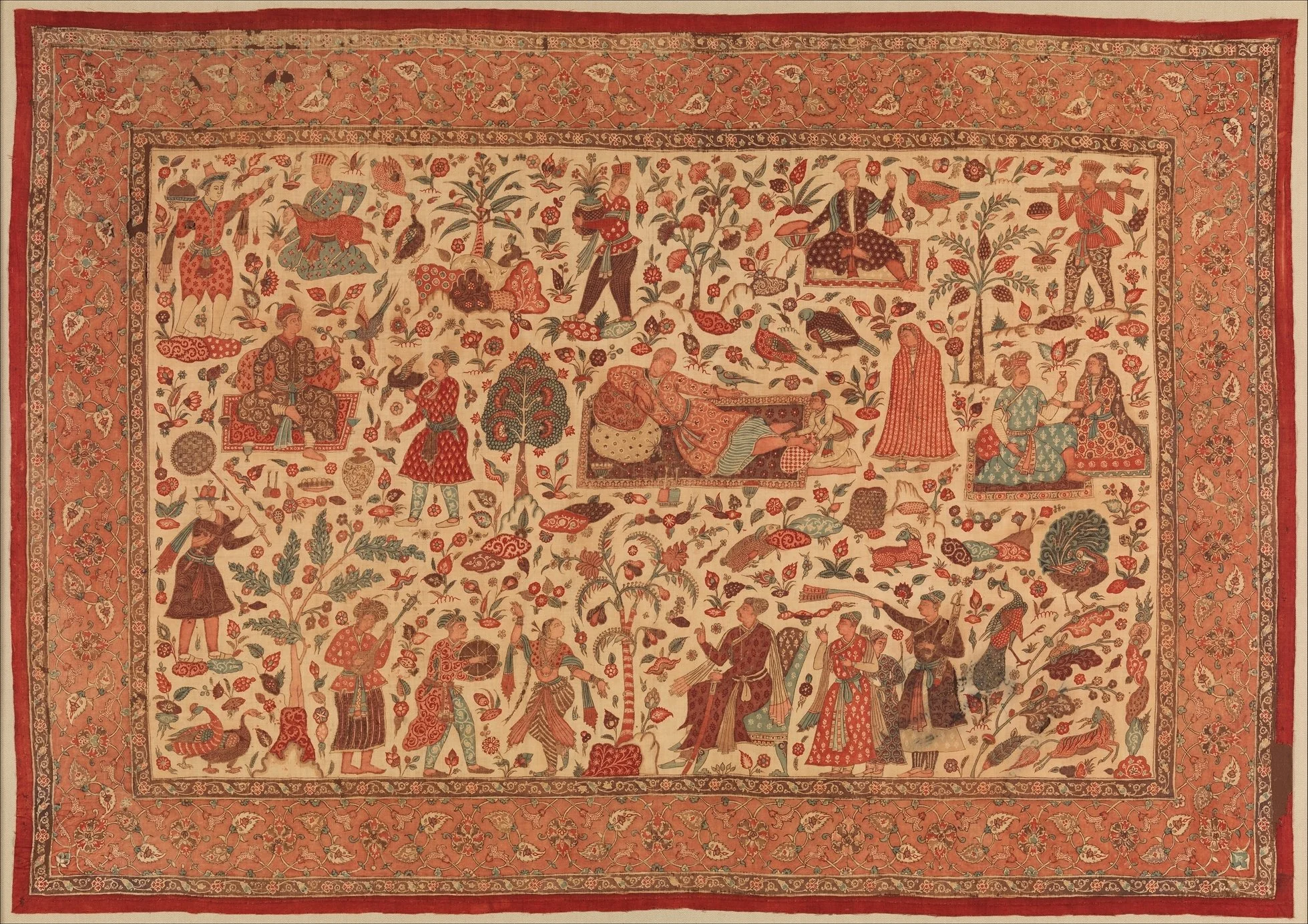
Kalamkari Rumal, c.1640-50, at The Met

I want to sit with that for a moment, because it is not simply an oversight. It reflects something about how the Gala and the museum operate as adjacent but non-communicating systems, and about whose art histories the “Costume Art” frame actually encompasses. The spectacle of contemporary fashion and the archive of historical craft do not speak to each other, even when they are literally in the same building. The institutional knowledge that might have made that connection visible, that might have asked what it means for painted cloth to return to an institution that holds its predecessors, was not part of the event’s frame. For an exhibition explicitly premised on illuminating connections between garments and the museum’s collections, that silence is telling.

This is where I want to think carefully rather than simply celebrate, and where I find myself in the most difficulty.

The visibility these ensembles create is real. But visibility and legibility are not the same thing as redistribution, and there is a version of this—one I am not sure we are not already watching—where “artisan visibility” becomes luxury narrative, where naming workers is part of the value proposition of couture rather than a challenge to its structure. The named artisans appear within Malhotra’s authorship, within the branding apparatus of couture, within a global event whose gatekeeping mechanisms are themselves a form of capital. “Fashion is Art” is, among other things, a frame that increases the cultural and therefore economic value of the objects it certifies. Naming artisans within that frame does not necessarily interrupt it; it may simply make the luxury object more legible, more storied, more valuable.

The deeper structures remain not merely unaddressed but largely unaskable within the celebratory frame. Naming artisans does not tell us about the artist composition in embroidery workshops. For instance, caste/religion is not incidental here when thinking about artist since the organization of skilled craft labor in India has been and remains structured by it. Naming artisans does not tell us about wage hierarchies within subcontracting chains, or about the gap between the labor hours cited in press releases and what artisans are actually paid for them. It does not tell us how value flows across the production process, or whether visibility at the Met Gala translates into anything material for Vipin, Karim, Abdul, and Das. These questions are not answerable from the red carpet. But the work of asking them—pursued by journalists and researchers who cover artisan economies, by labor organizers in the garment sector, by craft historians—exists, and the Gala’s frame does not acknowledge it. The ensembles open a door that the event structure immediately closes.

I am also aware that writing this analysis performs its own kind of value extraction: I am using these garments, and by extension these artisans and their labor, to demonstrate a set of art-historical competencies. The kalamkari observation is genuinely mine, but it is also convenient for me in ways I should not pretend are neutral.

None of this is reason to look away—from the garments, or from the difficulty.

What stays with me about both ensembles is that they refuse a certain simplification. They are not garments that flatten themselves for global readability. Instead, they insist on something the framing of “Fashion is Art” tends to suppress: that these objects were made, by specific people, drawing on specific traditions with specific histories, and that the making is not background but argument. The embroidery is not decorative accent; it is the argument. The Ravi Varma paintings are not backdrop; they are the subject-matter. Joharn and Malhotra did not wear abstracted “Indian” aesthetic to the Met steps; they showcased specific iconographic traditions, specific content and techniques with a specific history chosen with enough care to repay close reading. Malhotra did not gesture at artisan labor; he made it structurally present within the garment’s visual logic.

Now this is not structural change. It does not reach the caste hierarchies or the wage structures or the subcontracting chains. It does not resolve the irony of gesturing toward artisan communities within an event that now charges $100,000 a seat and counts tech billionaires among its underwriters. But within a context designed to transform everything into surface—including the “Fashion is Art” frame, which is also a way of aestheticizing things into palatability—these ensembles insisted on depth: on histories of making and meaning that do not resolve completely into spectacle without remainder.

Whether those openings get used is a different question, and a harder one. I am not sure this essay answers it.

"Unless we stand continually over them with rods in our hands...": Intimidating Indian Textile Workers in 17th Century

In the autumn of 1675, the East India Company’s Agent and Council at Fort St. George drafted a letter brimming with frustration.

The calicoes from Madras, they complained, had grown “much thinner and of less body than formerly.”
The merchants, they said, were “a people so false and so addicted to deceit.”
The weavers were careless; the washers “have already felt the smart of the whip.”

Across its stiff bureaucratic English, this document reveals the use of violence to produce order but also frustration and anxiety — the anxiety of some white British men facing a brown world that refused to obey.

Calico Printing in England, c. 1830s

Courtesy: Wellcome Collection, UK

Sidebar: Calico means many different things so I did go down the rabbit hole to figure out what exactly Calico might mean in this 1675 record. And I found it here!

Threads of Control

The Council’s response to Edward Terry, the factory’s English overseer, is a catalog of managerial anxiety with a full serving of the trope of lazy and deceitful Indians they have to endure.
Unless we stand continually over them with rods in our hands,” they wrote, “they will not act honestly.
Every process in this record — weaving, dyeing, washing, packing — is transformed into a moral drama of obedience and deceit. But this insistence on discipline betrays the anxiety of a system depended on Indian artisans and middlemen whose knowledge, skill, and timing were beyond the Council’s control.

We have often treated with the merchants, weavers, and washers, exhorting them to perform their several duties faithfully, and have severely punished such as we found faulty… but they are a people so false and so addicted to deceit, that unless we stand continually over them with rods in our hands, they will not act honestly.
— IOR/G/19/1 Part 5, p. 55, 1675 British East India Company Records, British Library

Cleverness

Even as the letter rails against deceit, it admits that the weavers and merchants “have taken all advantages of time and opportunity to advance the price of their yarn and labour.”

To me it appears that the artisans understood the rhythms of the market and the vulnerability of European buyers. Perhaps by adjusting production, claiming “scarcity of cotton” or “want of weavers,” they manipulated price and pace in ways that safeguarded their autonomy. They were, in effect shaping global textile flows long before industrial capitalism claimed that genius as its own.

Colonial Morality and the Language of Deceit

The repetition of “false,” “idle,” “deceitful” is less a description of behavior than an assertion of power. In my opinion, the British East India Company (EIC) imposed their own moral lexicon to recast negotiation as treachery. The visualization below shows exactly how many times words attached to an honor code or moral behavior is mentioned in this document that is roughly about 5 full (plano) foolscap papers long.

Moral and disciplinary vocabulary in the 1675 British East India Company document (please do not reproduce this image without permission)

When the Council ordered that “the Company’s mark be struck only by the warehouse keeper in presence of two witnesses,” they sought not quality but control — to erase the old circuits of trust that had governed textile exchange for centuries. Where local trade relied on relationships, memory, and credit, the Company introduced signatures, seals, and punishment; the tools of a surveillance economy.

But what if what the Company read as dishonesty was, in fact, something else?

When the Council complained that the merchants “have taken all advantages of time and opportunity to advance the price of their yarn and labour, pretending scarcity of cotton and want of weavers, though we know the contrary,” might this not suggest an older rhythm of commerce — one attuned to monsoon, credit, and caste, rather than to the clock and the ledger? When Edward Terry noted that the merchants “plead & remembrance of their contract with your Honours,” could it be that he was witnessing a different kind of contract altogether, one rooted in mutual obligation and reputation rather than fixed-price exchange? And when the weavers mixed different grades of cotton or paced their production unevenly, were they really being “careless,” or simply working according to environmental knowledge and inherited craft systems that the English failed to grasp? The constant refrain of “false,” “idle,” and “deceitful” perhaps tells us less about the artisans’ moral character and more about the Company’s discomfort before a market it could not encode to its wishes and perhaps a local economy that operated by its own logics of trust, time, and texture.

The Politics of Quality

The Company’s repeated complaint about “thin cloth” feels, on the surface, like a matter of quality control, but it really signals something larger. In calling for “callicoes… more substantial than those of former years,” they weren’t simply asking for better workmanship. They were trying to define what counted as good, honest labor. “Quality” became a way to talk about control: a language through which to police bodies, assign blame, and justify intervention. A flaw in the weave could be read as a flaw in character; a delay in curing cloth as a sign of laziness. In the name of improvement, the EIC factory remade itself as a kind of moral workshop, where every bolt of cotton could testify not just to skill, but to obedience and, even, morality.

Resistance in Routine?

At the close of the letter, the Council recorded the names of twenty-nine merchants and master weavers. Some of the names recorded were “Moodoo Naigue, Lutchmee Chetty, Narayana Chetty, Appa Naigue, Ramasamy Chetty.” These men, the Company claimed, “promised to observe the Honourable Company’s orders.

Read literally, it sounds like submission.

It makes one wonder if these merchants and weavers knew what they were signing. That they were signing a record confirming not just a textile production contract but also their purported immoral behavior and their corruption. Their names in this document marks presence rather than obedience, because in later years too these types of complaints were levied on merchants by generations of EIC officials.

Every directive in this 1675 document — view all cloth in the white, whip the washers, restrain the dyers — reveals how deeply the empire depended on the people it sought to discipline. Each repetition of “order” testifies to disorder, each attempt at control to the artisans’ quiet refusal to be mechanized without physical and monetary coercion and surveillance.


Preferred Citation: Deepthi Murali, “‘Unless We Stand Continually over Them with Rods in Our Hands...’: Intimidating Indian Textile Workers in 17th Century,” DeepthiMurali.com, [date accessed], www.deepthimurali.com/textiles-talk/a-1675-british-east-india-company-textile-workers-memorandum

October Art Focus: A Lungi in a 17th Century Portuguese Painting


Spot the figure in the lungi in the painting below


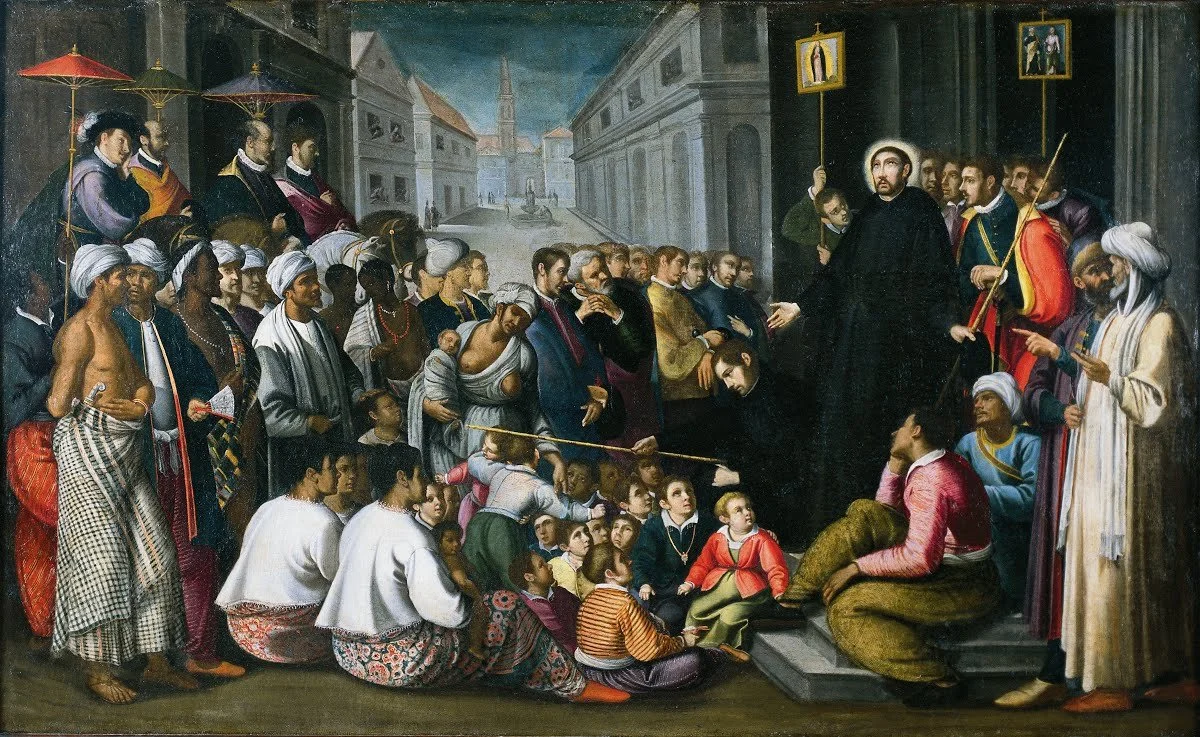
Saint Francis Xavier Preaching in Goa, André Reinoso, 1610, Lisbon, Portugal, Museu de São Roque/Santa Casa da Misericórdia de Lisboa

In the early seventeenth century, Portuguese painter André Reinoso created Saint Francis Xavier Preaching in Goa—one of twenty canvases narrating the life of the Jesuit missionary whose journeys popularized Christianity across Asia. Painted around 1610 (may be a little later), for the Jesuit Church of São Roque in Lisbon, the work reflects the fervent missionary spirit and global reach of early modern Catholicism.

Reinoso’s scene imagines a moment in Goa, then the heart of Portugal’s Indian Ocean empire. Saint Francis Xavier stands at the center, arm raised, addressing a crowd that includes Indian listeners in vivid dress, children gathered at his feet, and Portuguese soldiers and nobles on horseback. Though the artist never visited India, his rendering of costume and setting reveals a fascination with ethnographic detail—an attempt to visualize the “exotic” world of the East for European viewers.

In Lisbon, these paintings served both as devotional tools and as propaganda for Jesuit missionary triumphs abroad.

For me the most fascinating elements of this painting are of course the variety of textiles displayed. While Reinoso never visited India, Indian textiles were abundantly available in Lisbon at this time and I wonder if he may have sourced some of these textiles locally to use as samples in this painting. In any case, because I work with checked cotton textiles, I was excited to notice the lungi depicted here.

On the far right, closest to the viewer, stands a man in a lazy contrapposto posture, arm around waist gently resting on the top fold of his single wrap lungi.

The lungi—a simple, woven wrap of cotton—has been an essential garment in South India for centuries. Worn by men and women across Tamil Nadu, Kerala, and other parts of South India, it functions as both workwear and leisurewear, prized for its comfort in the tropical climate. Woven in local handloom centers in South India as well as in western India and Bengal, lungis are recognizable by their bold, yarn-dyed checks and stripes.

In the painting, the lungi is shown for what it is — the humble everyday wear of the working classes. It is easily identifiable and distinguishable not only as a textile but as a way to delineate the class structuring of the painting: the people to the left side of the Francis Xavier are Indians, to the right are Portuguese or Luso-Indian. The lungi-wearing man carries a nice dagger that is pushed into the waist of the lungi.

My second favorite element in the painting are the boisterous children in the middle not quite interested in the preaching and being disciplined by another missionary.

The details are so well-done in this painting and I have to remind myself that none of these paintings are documentary in its nature.

Curator John Guy talks about this painting briefly in a chapter about the very early globalization of the Indian textiles’ styles. He confirms that while not ethnographic, all these textiles you see people wearing in this painting are accurately portrayed. The book is available to read in full online.

Indeed, if you are familiar with the lungi, a black and white checked cotton lungi is something that is still worn in India today.

Though humble, the lungi’s history traces deep cultural and trade connections across the Indian Ocean. Its checked patterns and tubular form link it to a family of wrap garments—including the Burmese longyi and Malay sarong—that circulated through maritime exchange since early medieval times. By the eighteenth century, similar South Indian checked cottons were shipped worldwide as “Madras,” shaping fashion far beyond the subcontinent.

If you are curious about the use of Madras checks in the world, check out my collaborative digital history project
Connecting Threads: Fashioning Madras in the Caribbean.

In South India today, the lungi remains both a marker of local identity and a living textile tradition—adapted by powerloom and handloom weavers alike, bridging the ordinary and the global in a single piece of cloth.

Recommended Reading: Andrews, Jean. 2023. The Canonization of St Francis Xavier in Spanish Habsburg Lands: A Poetry Challenge in Madrid, Sacristy Paintings by André Reinoso in Lisbon and an Altarpiece by Pieter Pawel Rubens in Antwerp. Religions 14, no. 12: 1505.

Did you know the area of Chintadripet in Chennai was founded by Tamil weavers?

An illustration from an 1850 book “Life in India or Madras, the Neilgherries, and Calcutta” by John Welsh Dulles showing a temple in Chintadripet, Chennai.

If you’ve ever driven past the narrow lanes of Chintadripet in central Chennai — now lined with hardware shops, workshops, and temples — you’re passing through what was once one of the earliest planned textile villages in colonial South India.

In the mid-eighteenth century, the East India Company called it Chindadry Petta. But it was founded not by British officials, but by Tamil weavers who built it, managed it, and gave it life.

A Village of Looms and Promises

Around the 1730s, Company officials at Fort St. George decided to finance a village for textile production. They wanted a site where weavers could be organized, monitored, and financed for export work, a kind of proto-industrial settlement designed to feed Europe’s hunger for Indian cotton. To make this happen, they turned to two local men: Narryn and Chintomboy (Naran and Chinnatampi in Tamil I presume), hereditary weavers who were brothers. They were promised privileges: tax exemptions, freedom to manage their affairs, and a small grant of 300 pagodas to build houses for the weavers. These privileges were the same as the Company provided their father Timan.

Their efforts succeeded. The new settlement, called Chindadry Petta in British East India Company records, soon hummed with over 600 looms producing chintz, moorees, and ginghams. Every piece of textile from this village when exported bore a stamped mark: “Chindadry Petta.” But Chindadry Petta wasn’t just a Company worksite. It was a community. The brother built temples for weavers who settled there to worship at and tanks to help with cloth washing and other needs. They convinced nearby merchants to contribute annual donations for religious upkeep, and even obtained a parwana from the Nawab of Carnatic, Safdar Ali Khan, thus guaranteeing a steady allowance for the temples.

War, Loss, and a Plea

Then came the French attack on Madras in 1746 in the First Carnatic War. Chindadry Petta was plundered. Warehouses were looted, cloth worth thousands of pagodas was destroyed, and homes and temples were burned.

When peace returned, the sons of the two founder brothers, Jaggoo and Chengalroyah, submitted a petition to the British Deputy Governor in 1750. Their fathers, they wrote, had “taken great trouble” to make the village flourish. They had borrowed money to pay weavers and keep the looms running even during crisis.

Now everything was gone.

They asked for recognition, and for compensation for the losses “their fathers sustained by the loss of Madras.” Their words are deferential, yet deeply human: a quiet record of artisans trying to rebuild after empire’s wars.

A Living Legacy

Nearly three centuries later, Chintadripet still bears the traces of that history. The old temples of Siva and Perumal, the grid-like street plan, and the enduring presence of small-scale workshops all echo its origins as a planned weaving quarter.

Their petition from 1750, preserved in the British Library’s India Office Records, reminds us that the foundations of colonial Madras were not laid by imperial engineers alone. They were woven, quite literally, by the hands of local artisans who made the city — and its textiles — their own.

Suggested Citation

Murali, Deepthi. “The Weavers of Chindadry Petta: A Petition from the Heart of Colonial Madras.” Connecting Threads Digital History Project (2025). Based on British Library, India Office Records, IOR G/18/15, pp. 191–192. CC BY-NC 4.0.

🧵 Context Note: What Was Chindadry Petta?

Chindadry Petta, the colonial name for today’s Chintadripet, was established around 1734 under East India Company supervision.
It was designed as a “weavers’ village” supplying cotton goods for export to Britain.
Hundreds of looms, dyers, and spinners lived within its walls, working under hereditary leaders who negotiated directly with Company officials.
Its Tamil name, often written Chinna Tari Pettai — “small loom quarter” — captures its identity as both a production hub and a living neighborhood.
When the French destroyed it in 1746, local weavers rebuilt it almost immediately — a testament to the resilience that continues to define Chintadripet’s working-class heart today.