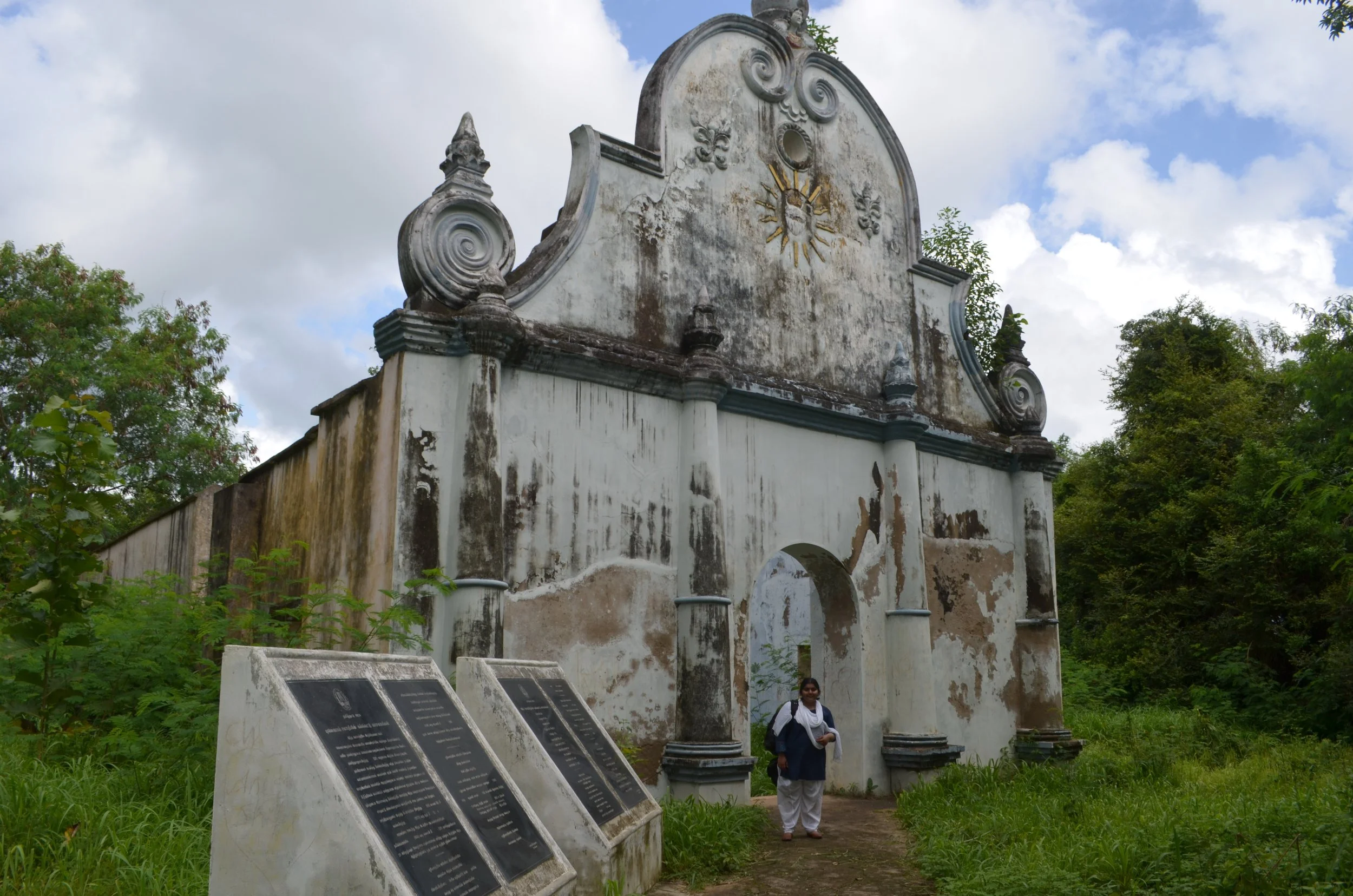
High on a rocky hill just southeast of Padmanabhapuram in the Nagercoil District of Tamil Nadu stands Udayagiri Fort. Built in the mid-18th century, this sizable fort is easy to miss today. Within it the only remaining structures is the ruined chapel that barely announces itself amid dense vegetation. And yet, inside that chapel survives a small but extraordinary archive: a cluster of grave stones on the unmade floor of the chaptel that preserve the presence of European militia in eighteenth-century South India.
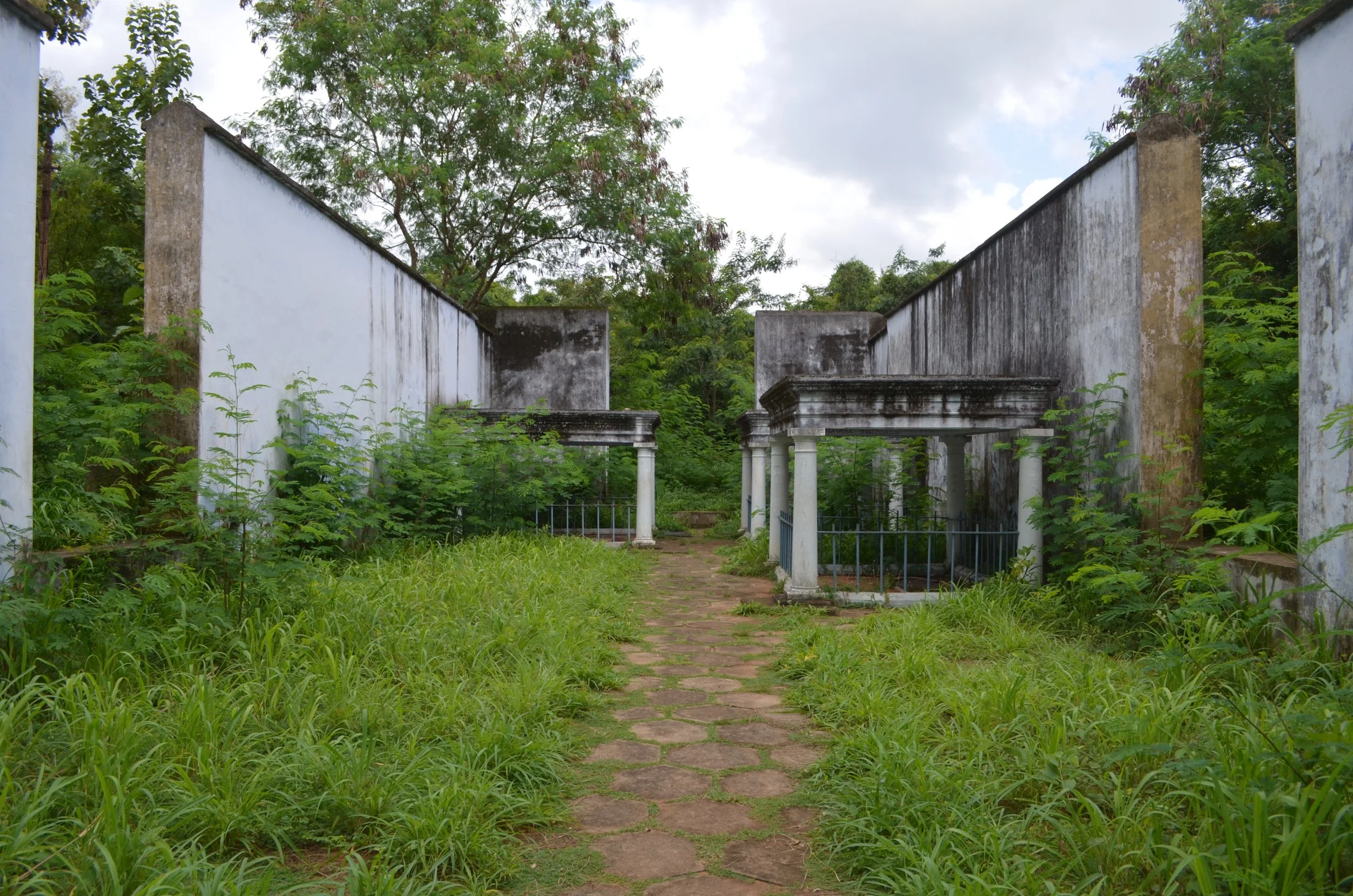
Chapel Interior
The epitaph stones inside the ruined chapel commemorate European military officers—and their families—who lived and died in the service of the Travancore state. They were not colonial administrators or East India Company officials. They were soldiers—Flemish, German, and British, who pledged loyalty to Marthanda Varma (r. 1729-1758) and his successor. These were men who operated within local political and calendrical systems and essentially cut ties with their homelands. They were born in Europe but never went back, choosing India as their final resting place.
When you read the epitaphs on these grave markers closely—across text, image, and language—they reveal how sovereignty, military labor, faith, and belonging functioned in South India for these “foreigners.”
The Fort
Udayagiri Fort rose to prominence during the reign of Marthanda Varma, whose rule reshaped the political geography of southern Kerala and southwestern Tamil Nadu. His reign was defined by territorial consolidation. He brought Attingal, Kayangulam, Kollam, and Ambalapuzha under Travancore control. And with the conquest of Tiruvidangodu in the far south, Padmanabhapuram emerged as a strategic center of governance.
The fort at Udayagiri functioned as arsenal, garrison, and stronghold at a stone’s throw away from Padmanabhapuram Palace, Marthanda Varma’s capital complex. It is said that Udayagiri was fortified to house Europeans in the Travancore army and functioned as a space where the king could meet his non-Hindu militiamen without them stepping into the sacral Padmanabhapuram palace. Enclosing nearly eighty-five acres and rising more than 260 feet above the surrounding landscape, the fort’s granite ramparts were both defensive infrastructure and a statement of state power. The European officers buried here were not incidental to this process; they were integral to the military reforms that made Travancore and its rise as a formidable regional power in the mid-18th century.
The Vallia-Kappittaan (“Great Captain”)
The most prominent figure buried at Udayagiri is Eustachius De Lannoy, remembered locally as the Vallia-Kappittaan—the “Great Captain.” His Latin epitaph opens with a familiar early modern injunction:
Siste, viator!
Stop, wayfarer!
What follows is a tightly compressed biography in both visuals and text, heavy with military and moral emphasis. De Lannoy is identified as dux generalis, General-in-Chief, who commanded the Travancore army and “for nearly thirty-seven years served the king with the greatest fidelity.” The language is explicit about how authority was exercised: “by the might of his arms and the terror of his name,” he subjected rival kingdoms “from Kayangulam to Cochin” to royal sway.
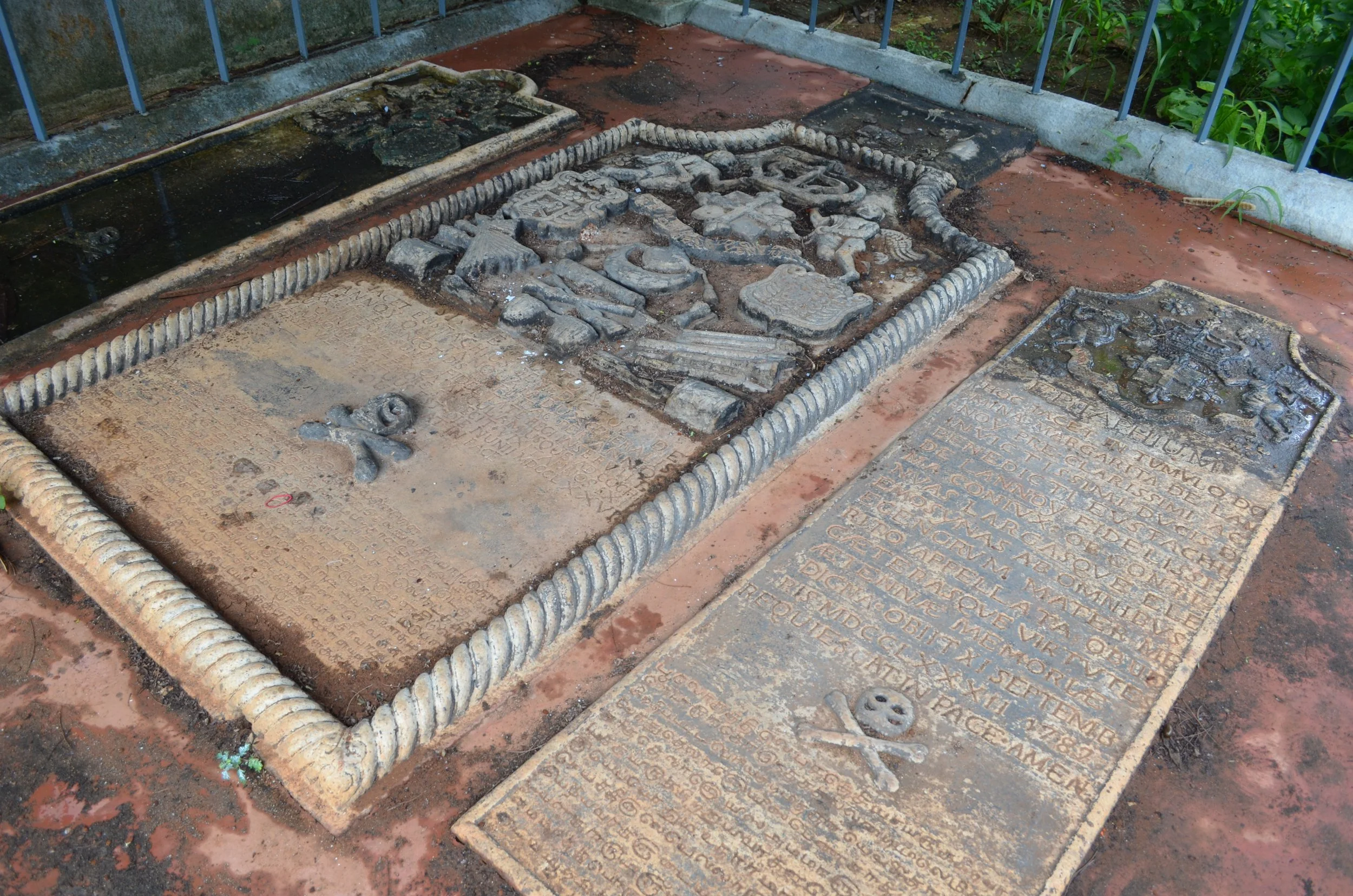
Ledger stones marking the graves of the De Lannoy Family
The commemoration is written in both Latin and Tamil.
The Tamil epitaph does not merely translate the claims made in Latin; it reframes it. Where the Latin stresses fidelity and fear, the Tamil repeatedly pairs military force with royal grace. De Lannoy’s success is attributed not only to the strength of his arms and the fame of his name, but also to the favor of the king. This is a recognizably South Indian idiom of sovereignty, one that situates military command firmly within royal authority rather than personal charisma.
Even the dating of his death underscores this localization. The Latin records that he died on June 1, 1777. The Tamil specifies more: Sunday night, the 22nd day of Vaikasi, in the 952nd year of the Kollam Era. Time itself is rendered legible through local systems.
Reading the Visual Program
The epitaph’s visual program reinforces this textual emphasis with remarkable clarity. The slab is organized as a heraldic–emblematic field. The body of the deceased is absent and identity is constructed through symbols.
A twisted rope border encloses the ledger stone, creating a bounded moral and institutional space, a common European early modern visual device. At the top center sits the papal tiara with crossed keys, a clear assertion of Roman Catholic orthodoxy. For a European officer serving a Hindu king, this symbol matters. It declares that service to Travancore did not compromise Catholic legitimacy. Salvation and doctrinal authority remain anchored in Rome, unthreatened by de Lannoy’s fidelity to a Hindu ruler. Flanking angels act as heraldic supporters to the papal symbol, much like they do in these types of funerary markers in Europe. However, the angelic figures in these epitaphs are distinctly Indic in their appearances.
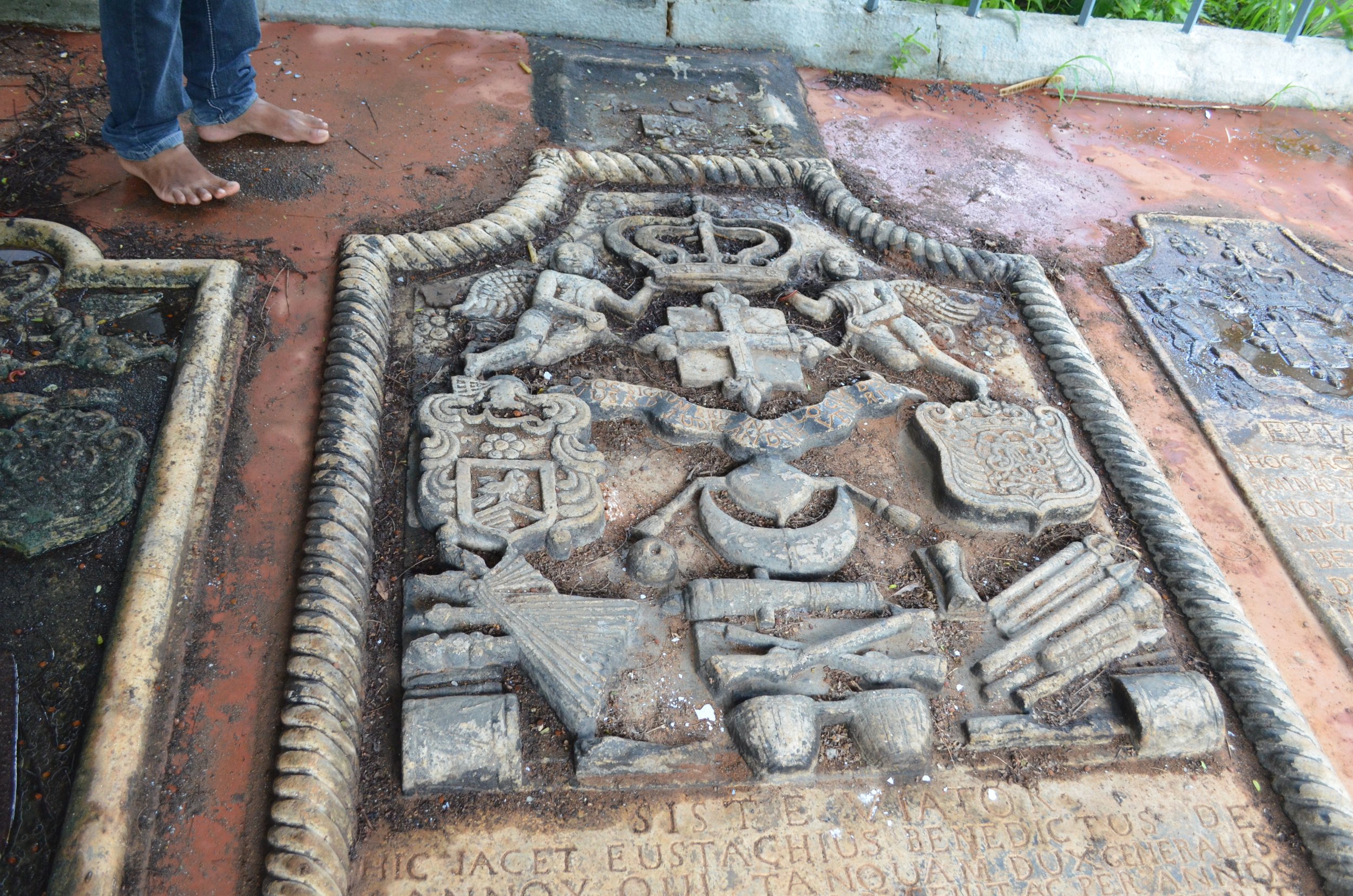
Visual program accompanying the epitaph
Along the central vertical axis, the cross binds papal authority above to human action below, visually asserting that worldly military service is ultimately subordinated to Christian salvation. The Latin scriptural line above—“This shall be the sign in heaven when the Lord shall come to judge”—makes that hierarchy explicit. Shields on either side right below the cross and keys anchor De Lannoy in his lineage. Most likely these are his fraternal and maternal family heralds.
The lower register is the most revealing. At its center are unmistakable signs of military labor: a cannon, rifles or muskets, and kettledrums. These are not decorative flourishes. Kettledrums, in particular, signal command and ceremonial authority within South India military culture of the time. To the right appear spears, polearms, and edged weapons. The visual vocabulary here is emphatically martial. To the left are accordions of olas or cadjan leaf records, perhaps marking Lannoy’s administrative authority.
The importance within the iconography, however, is not of scholarship or bureaucracy. It is the material culture of organized warfare.
Military Service and Faith
Taken together, the text and image construct a life defined by disciplined military service, exercised under royal authority and sanctified through Catholic faith. The Latin epitaph closes with a familiar prayer—Requiescat in pace—while the Tamil elaborates further, noting that De Lannoy died “comforted with all the sacraments of the Holy Roman Church.” The final emphasis is not on victory, but on proper Christian death.
This is not incidental. The epitaph works hard to reconcile two potentially competing loyalties: service to a Hindu Indian sovereign and fidelity to a universal Church and its god. And that tension is resolved within the ledger stone by placing military labor within a visual hierarchy that culminates in salvation.
European but also Indian
The chapel preserves not only De Lannoy’s grave, but those of his immediate family. His son, Johannes Benedictus De Lannoy, was born in Travancore. He most definitely spoke Tamil and Malayalam. Did he also speak Flemish like his father? Did he speak Creole Portuguese which was lingua franca still in the region?
Johannes followed his father into military life but died at just nineteen after being wounded at the battle of Fort Kalakkad in 1765. His epitaph records this trajectory with painful precision, listing birth, injury, prolonged suffering, and death.
Margaret De Lannoy, wife and mother, outlived them both and is remembered for her charity rather than rank. Her epitaph hails her as “the mother of the poor.” The family graves lie together, arranged chronologically, a quiet material record of settlement, loss, and belonging.
Other Europeans at Udayagiri
The other epitaphs at Udayagiri tell similar stories of long service, early death, and domestic vulnerability. Officers like Peter Flory and Peter Charles Everard are remembered for fidelity rather than conquest. The graves of Captain A. R. Hughes’s infant sons record the fragility of family life. Anne Rouse’s monument, erected at her daughter’s request, gestures toward European family networks extending across generations in Travancore. It is notable that these other Europeans may not have been Flemish like De Lannoy.
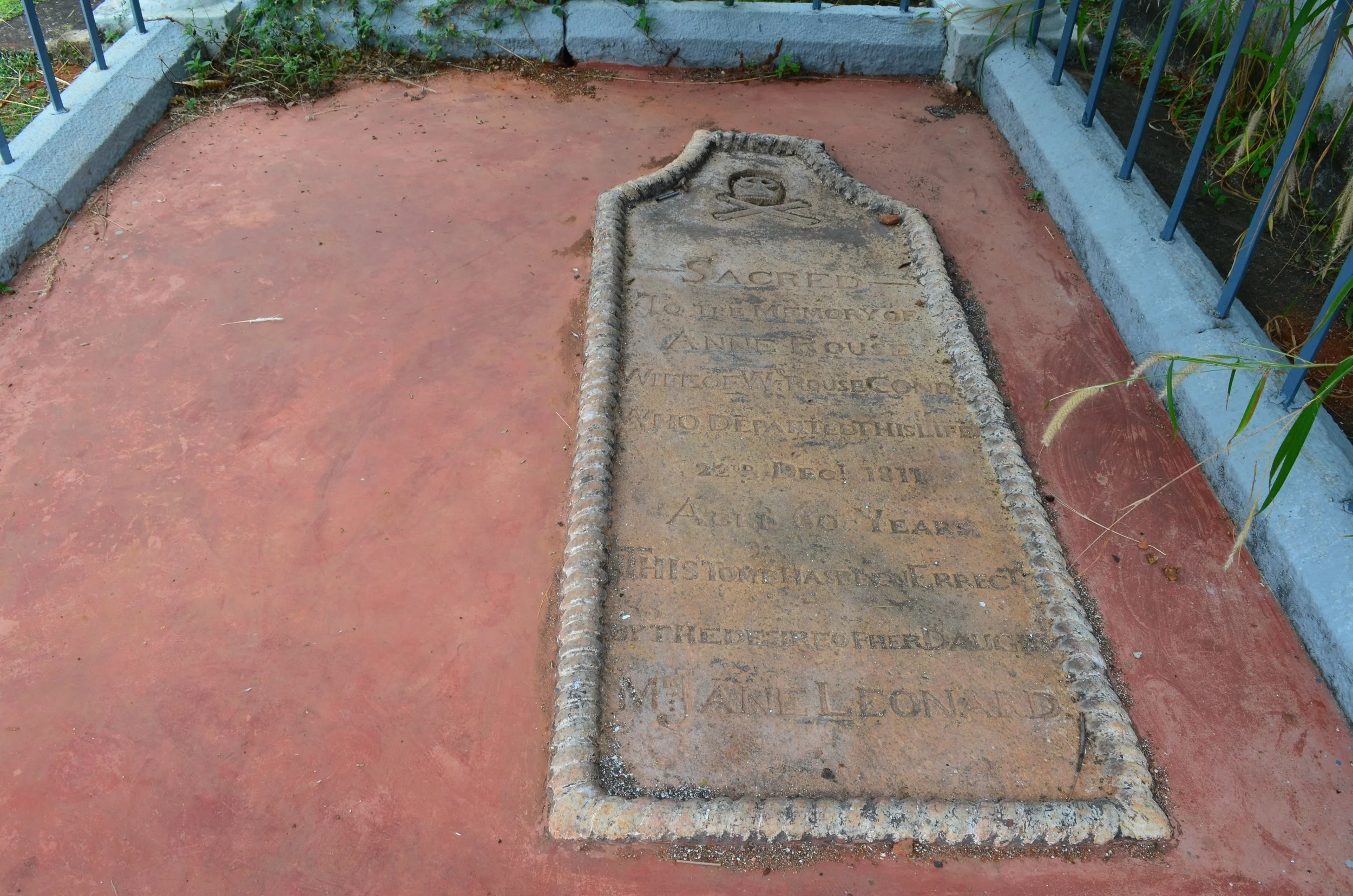
Ledger stone for Anne Rouse
Stone as Archive
These stone markers show Europeans who were not colonizers acting on behalf of a western empire. Nor were they fully assimilated locals. They occupied a more ambiguous position: professional military servants of an Indian state, embedded in local political structures while maintaining Catholic ritual life and European identity.
The stones themselves matter as historical objects. Latin and Tamil inscriptions coexist. Kollam-era dates sit beside papal insignia. Cannons and kettledrums appear beneath crosses and Indianized angels. These epitaphs were crafted to be read by a multicultural, and dare I say, pluralistic world, making claims about loyalty, authority, faith, and service through material form.
Memory and Fragility
The epitaphs were translated in the early twentieth century and recorded in the Travancore Archaeological Series (Vol. 6).
I visited the chapel first in 2013 and then in 2015. Perhaps because I went during monsoons in 2015, the markers were covered in mud and debris the second time. The chapel itself as you can see from the first image above is in ruins, the roof having fallen down a long time back.
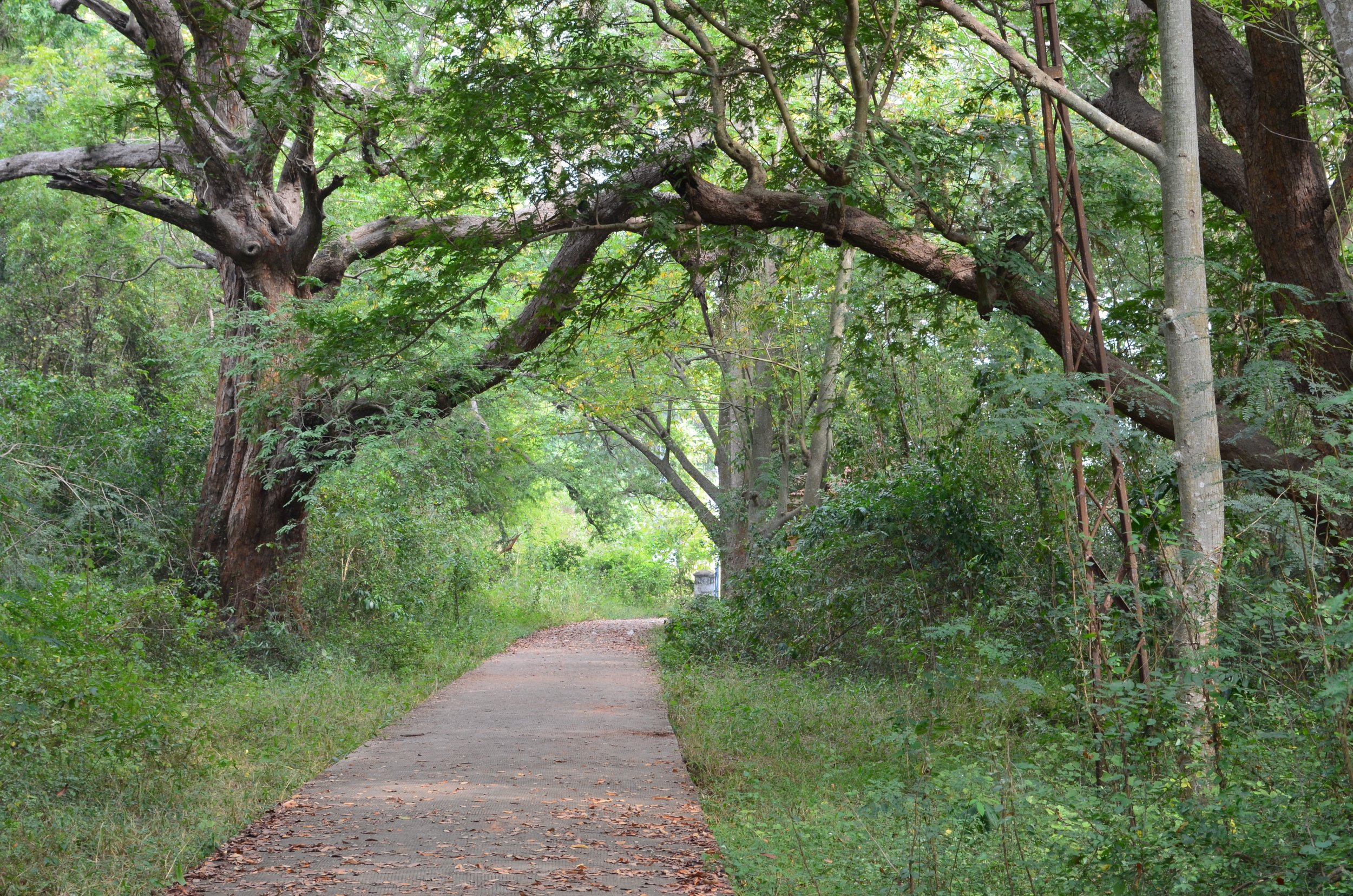
Inside Udayagiri Fort
If you want to know more about de Lannoy, the best book I can recommend is The Kulasekhara Perumals of Travancore: History and State Formation in Travancore from 1671 to 1758 by Mark de Lannoy. (Not sure if the author is related to Travancore’s Valia Kappithaan!)